on
Demystifying FTTH: Inside Your Fiber Optic Connection
Fiber Optic Networks
Recently, I asked myself how network packets flow to a home that is connected to the Internet via Fiber to the Home (FTTH). A practical example sheds light on this: Let’s say a single response packet in the form of a Kagi search result tries to find its way from one of Kagi’s servers back to my laptop.
Kagi is hosted on Google Cloud (ironic, isn’t it?), so the response packet is generated on a server that resides within a Google-owned autonomous system (AS). An autonomous system is essentially a collection of IP routing prefixes controlled by an organization, in this case, Google. Google peers with other autonomous systems, forming a global network of ASes that eventually include my Internet Service Provider (ISP). A simple mtr call reveals the involved ASes.
mtr -4 --aslookup --no-dns kagi.com
The packet traverses from AS396982 (Google Cloud) via AS12956 (Telxius Cable) to AS3352 (Telefonica de España). As you might guess, this post is written from Spain. Routers in between these autonomous systems peer and exchange routing information via BGP.
What happens once my ISP, the last involved AS, receives the packet?
The ISP (Telefonica de España) uses conventional routing to move the packet to one of its Points of Presence (PoP), which are essentially local offices or data centers that house enterprise-grade networking equipment. The central piece of equipment here is the Optical Line Terminal (OLT). An OLT serves as the gateway for thousands of customers, acting much like a massive network switch that connects them to the broader internet.
At the other end of the OLT is the Optical Network Terminal (ONT), which is the fiber modem sitting in your home. The connection in between OLT and ONT can be active or passive. In Active Optical Networks (AON), each ONT has a dedicated fiber line going to the OLT, with electrically powered networking equipment along the way. In Passive Optical Networks (PON), multiple ONTs share a single fiber line up to a distribution point, where a dumb splitter duplicates the light signal to 64 or 128 fibers, that connect to the ONTs. In my case I’m connected via PON, so the Kagi packet journey can be summarized as follows:
- The packet travels across various Autonomous Systems until it reaches the ISP’s core network.
- Within the ISP’s network, it is routed internally to the appropriate local PoP and into the OLT.
- The OLT identifies the destination ONT, encapsulates the packet within a PON frame, and encrypts it (typically via AES) for secure transmission.
- This PON frame is transmitted over a single optical fiber and hits an unpowered optical splitter, which physically broadcasts the light signal to all 64 ONTs on that branch.
- The PON frame arrives at all 64 homes. However, each ONT is programmed to filter for its specific hardware identifier. It drops everyone else’s traffic, decrypts its own frames, and forwards the enclosed IP packets to your local Wi-Fi router.
This architecture is shown below.
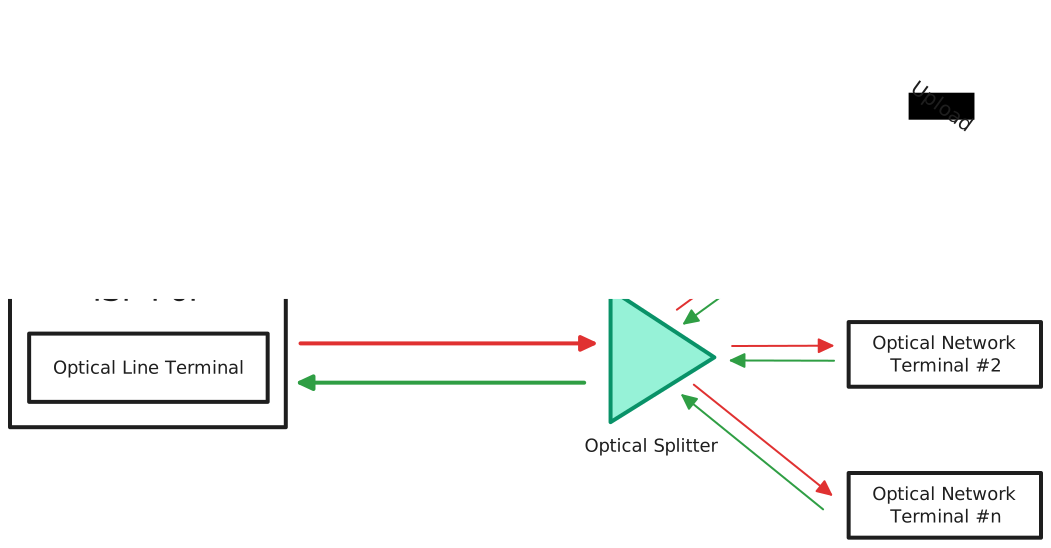
For uploads, the OLT acts like a traffic cop. It orchestrates precise upload time slots for each ONT (adjusting for the microsecond delays caused by physical distance) so that their uploads are cleanly multiplexed onto the single fiber without crashing into each other. Uploads and downloads use different wavelengths (essentially different colors of light) to prevent collisions.
Several interesting facts come to light regarding this setup:
- PON networks become entirely passive behind the OLT. There is no electricity required between the PoP and your house. This means lower operating costs, minimal maintenance, and extreme robustness to power outages. As long as your home and the PoP have power, they are connected.
- Currently, XGS-PON enables 10 Gbit/s symmetrically per PON port. 25G-PON and 50G-PON are already standardized and seeing active deployment. Because the glass fiber in the ground easily supports Terabit speeds, upgrading the network usually only requires swapping the active endpoint hardware—the optics at the PoP and the ONT in your home.
- The bandwidth of a single PON port is a shared medium amongst all end customers on that splitter (usually up to 64). The ISP relies on heavy oversubscription, assuming not everyone will download huge files at the exact same millisecond.
- In comparison, Active Optical Networking (AON / Point-to-Point) provides a dedicated, un-split fiber directly from the PoP switch to the customer. This guarantees bandwidth but requires vastly more fiber cables and data center networking equipment.
- DSL is an older active network technology that relies on copper telephone cables.
- Internet via TV copper cable (DOCSIS) uses a shared medium much like PON, originally built to broadcast identical TV channels to whole neighborhoods.
Fiber is a Natural Monopoly
Who owns the fiber cable? In most countries, the answer is private companies. This is despite fiber being strategically vital infrastructure.
Counterexamples exist: Switzerland has famously bet on a four-fiber Point-to-Point (P2P) model. When the street is dug up, four physical glass strands are pulled into every single apartment. Swiss regulators realized early on that digging up the street to lay cables is a natural monopoly, much like laying water pipes or electrical grids. Having three different companies dig up the same sidewalk to lay proprietary cables makes zero economic or environmental sense.
The tragedy of the PON model is that it physically breaks the ability to share the network at the most fundamental level. Because 64 homes share a single strand of glass connected to one specific provider’s OLT, that provider cannot physically unplug just your connection and hand it to a competitor. Instead, competitors must rent virtual “Bitstream” access, keeping the original builder in total control of the hardware.
In contrast, in Switzerland, the Point-to-Point architecture means every home has four dedicated glass strands running all the way back to the PoP. Because three strands are left empty, competitors can easily enter the market. ISPs aren’t renting virtual bandwidth; they are renting physical “Dark Fiber” (Layer 1 access). An independent Swiss ISP like Init7 can walk into a PoP, rent your specific dark fiber for a regulated flat rate of about 15 to 20 CHF per month, plug it directly into their own massive Ethernet switches, and instantly offer you 25 Gbps symmetrical speeds. Despite the industry arguing that PON massively saves cost, this 25 Gbps connection costs less than a 1 Gbps connection in Germany.1
See Init7 Fiber7 vs Telekom Glasfaser 1000 (data as of 2025-04-24). ↩︎
Loading comments...